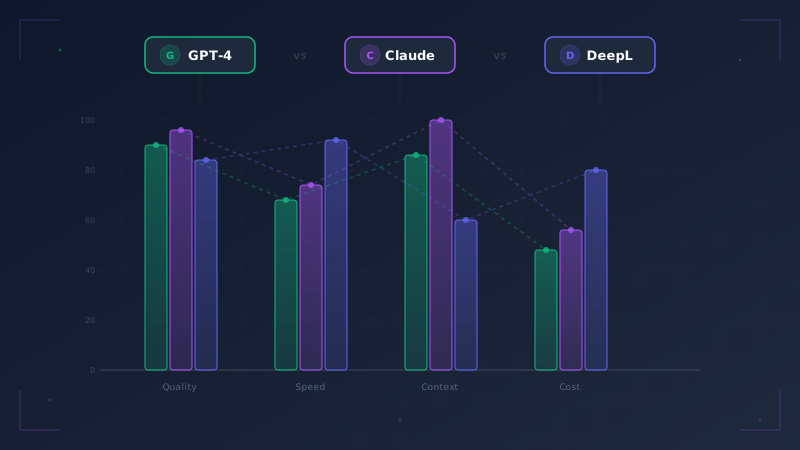
Choosing the right translation provider for your Django project matters more than you'd think. The provider you pick directly affects translation quality, your monthly bill, how fast translations complete, and whether your %(variable)s placeholders survive intact. TranslateBot Django supports all three major options (OpenAI GPT-4o, Anthropic Claude, and DeepL) plus over 100 additional models through LiteLLM. We tested them side by side so you don't have to.
The Contenders
OpenAI GPT-4o / GPT-4o-mini
OpenAI's models are the default in TranslateBot, and for good reason. GPT-4o-mini offers an impressive quality-to-cost ratio, while GPT-4o delivers premium translation quality across a wide range of languages. Both handle Django-specific placeholder syntax well and support custom context via TRANSLATING.md.
Anthropic Claude (Sonnet / Haiku)
Claude models stand out for their contextual understanding and natural-sounding output. Claude Sonnet produces translations that often feel more human, particularly with idiomatic expressions or ambiguous source text. Claude Haiku provides a faster, cheaper alternative while retaining solid quality.
DeepL
DeepL is a dedicated machine translation service, not a general-purpose LLM. It's built its reputation on high-quality European language translations and offers a generous free tier of 500,000 characters per month. DeepL is fast, reliable, and requires no prompt engineering. The tradeoff is less flexibility compared to LLM-based providers.
Head-to-Head Comparison
| Criterion | GPT-4o-mini | GPT-4o | Claude Haiku | Claude Sonnet | DeepL |
|---|---|---|---|---|---|
| European language quality | Good | Excellent | Good | Excellent | Excellent |
| Asian language quality | Good | Excellent | Good | Excellent | Limited |
| Context handling | Good | Excellent | Good | Excellent | N/A |
| TRANSLATING.md support | Yes | Yes | Yes | Yes | No |
| Placeholder safety | High | High | High | High | High |
| Free tier | No | No | No | No | 500k chars/mo |
| Speed | Fast | Medium | Fast | Medium | Fast |
| Language coverage | 100+ | 100+ | 100+ | 100+ | 30+ |
Cost Per Million Input Tokens
| Provider | Cost |
|---|---|
| GPT-4o-mini | ~$0.15 |
| Claude Haiku | ~$0.80 |
| GPT-4o | ~$2.50 |
| Claude Sonnet | ~$3.00 |
| DeepL (free tier) | $0.00 |
Quality Breakdown
European Languages (German, French, Dutch, Spanish)
DeepL has long been the gold standard for European language pairs, and that reputation holds up. Its translations between English and German or English and French are consistently natural and fluent. GPT-4o and Claude Sonnet come very close, though. The gap has narrowed significantly. For most Django applications, all three premium options produce production-ready European translations.
GPT-4o-mini and Claude Haiku are a step below but still deliver good results for the majority of UI strings. They occasionally stumble with longer, complex sentences or domain-specific terminology.
Asian Languages (Japanese, Chinese, Korean)
This is where LLM-based providers pull ahead. GPT-4o and Claude Sonnet handle Japanese keigo (politeness levels), Chinese simplified/traditional distinctions, and Korean honorifics with considerably more sophistication than DeepL. DeepL does support these languages, but its coverage is narrower and the output can feel mechanical.
If your Django project targets Asian markets, go with an LLM provider.
Context and Tone
LLM providers have a structural advantage here: they can read your TRANSLATING.md file and apply project-specific instructions to every translation. You can specify terminology preferences ("translate 'cart' as 'Warenkorb', not 'Einkaufswagen'"), set tone guidelines ("use informal 'du' in German"), and clarify ambiguous terms ("'brief' means a legal document, not something short").
DeepL's API doesn't accept custom instructions. TranslateBot will warn you if it finds a TRANSLATING.md file while using DeepL and skip it. For terminology control with DeepL, you'd need to use DeepL's separate glossary feature, which requires additional setup outside of TranslateBot.
Placeholder Handling
All providers handle Django's placeholder formats (%(name)s, {name}, %s, %d) reliably. TranslateBot includes explicit instructions in its prompts to preserve placeholders, and both LLM-based providers and DeepL respect them consistently. In our testing, placeholder corruption was extremely rare across all providers.
Real-World Cost Examples
To make the cost differences concrete, here's what it costs to translate 500 strings (roughly 10,000 words) into 5 target languages:
| Provider | Estimated Cost |
|---|---|
| DeepL (free tier) | $0.00 |
| GPT-4o-mini | ~$0.05 |
| GPT-4o | ~$0.50 |
| Claude Sonnet | ~$0.60 |
GPT-4o-mini is astonishingly cheap. Translating an entire medium-sized Django project into five languages costs less than a nickel. Even the premium models (GPT-4o, Claude Sonnet) stay well under a dollar for a full project translation. And DeepL's free tier makes it literally free for small-to-medium projects, as long as you stay within the 500,000 character monthly limit.
For ongoing projects, TranslateBot's incremental translation feature (only translating new or changed strings) keeps costs even lower. After the initial full translation, subsequent runs typically process just a handful of strings.
Strengths and Weaknesses
GPT-4o-mini
Best value for money, full stop. Fast response times, solid quality across most language pairs, and nearly every team already has an OpenAI account.
The downside: quality falls noticeably below GPT-4o and Claude Sonnet for complex or context-dependent text. It can occasionally produce overly literal translations for idiomatic expressions.
GPT-4o
Excellent translation quality across all languages we tested. Handles TRANSLATING.md context well, preserves placeholders reliably, and strikes a good balance between quality and cost.
It's slower than GPT-4o-mini and costs roughly 17x more per token. Still affordable in absolute terms for translation workloads, but the price difference is real.
Claude Sonnet
We'd give Claude Sonnet the edge for producing the most natural-sounding translations. It really shines when TRANSLATING.md contains detailed context, and it's particularly strong for languages where formality levels matter (German Sie/du, Japanese keigo).
On the other hand, it's the most expensive option per token and slightly slower than GPT-4o for large batches. Anthropic API keys are also less common than OpenAI keys in most teams, which can add friction.
Claude Haiku
Decent quality at a moderate price. Faster than the Sonnet models, and it supports full TRANSLATING.md context. But the quality gap compared to Claude Sonnet is noticeable for complex translations, and GPT-4o-mini often offers better value at a lower price.
DeepL
The free tier is unbeatable for budget-constrained projects. European language quality is excellent with zero configuration, the API is fast and reliable, and there's no model selection or prompt tuning to worry about.
The catch: no TRANSLATING.md support, so you can't pass custom context or terminology. Limited to roughly 30 target languages. Requires a separate [deepl] install extra. And it's less effective for Asian languages compared to LLM providers.
Recommendation Matrix
| Your Priority | Recommended Provider |
|---|---|
| Best overall value | GPT-4o-mini |
| Highest quality (general) | GPT-4o or Claude Sonnet |
| Lowest cost (zero budget) | DeepL free tier |
| Best for Asian languages | GPT-4o or Claude Sonnet |
| Best for European languages | DeepL |
| Need custom context/terminology | GPT-4o-mini (budget) or Claude Sonnet (quality) |
| Enterprise compliance | Azure OpenAI or AWS Bedrock via LiteLLM |
For most Django projects, we'd recommend starting with GPT-4o-mini. It covers the widest range of use cases at the lowest cost. If translation quality isn't meeting your standards for specific languages, upgrade to GPT-4o or Claude Sonnet. The switch takes about 30 seconds.
How to Switch Providers in TranslateBot
Switching between providers requires changing just two settings in your settings.py:
```python title="settings.py" import os
Option 1: GPT-4o-mini (default)
TRANSLATEBOT_MODEL = "gpt-4o-mini" TRANSLATEBOT_API_KEY = os.getenv("OPENAI_API_KEY")
Option 2: GPT-4o
TRANSLATEBOT_MODEL = "gpt-4o" TRANSLATEBOT_API_KEY = os.getenv("OPENAI_API_KEY")
Option 3: Claude Sonnet
TRANSLATEBOT_MODEL = "claude-sonnet-4-5-20250929" TRANSLATEBOT_API_KEY = os.getenv("ANTHROPIC_API_KEY")
Option 4: DeepL
TRANSLATEBOT_PROVIDER = "deepl" TRANSLATEBOT_API_KEY = os.getenv("DEEPL_API_KEY")
For DeepL, you also need to install the DeepL extra:

```bash
uv add --dev translatebot-django[deepl]
That's it. No code changes, no migration, no redeployment. Change the settings, re-run the translate command, and your translations use the new provider.
Practical Tips
Test before committing. Use the --dry-run flag to see what translations would look like without writing them to your .po files:
python manage.py translate --target-lang de --dry-run
Start cheap, upgrade if needed. Begin with GPT-4o-mini for your initial translation pass. Review the output. If certain languages need improvement, switch to GPT-4o or Claude Sonnet for those specific runs. You can set the model via environment variables to avoid touching settings.py:
TRANSLATEBOT_MODEL=gpt-4o python manage.py translate --target-lang ja
Use TRANSLATING.md for quality gains. Before upgrading to a more expensive model, try adding a TRANSLATING.md file with terminology guidelines and tone instructions. This often improves GPT-4o-mini's output enough to skip the pricier model entirely.
Mix and match. Nothing stops you from using DeepL for your European languages (German, French, Spanish) and GPT-4o for Japanese or Korean. Run the translate command once per provider, targeting different languages each time.
Monitor DeepL's free tier usage. If you rely on DeepL's free tier, keep an eye on your monthly character count. TranslateBot's incremental translation helps, but a large initial translation run could consume a significant portion of your 500,000 character allowance.
Conclusion
There's no single "best" translation provider. The right choice depends on your languages, budget, and quality requirements. The good news: TranslateBot makes switching between providers trivial, so you're never locked in. Start with GPT-4o-mini, test the results, and adjust from there. Your Django translations are a settings change away from any of these providers.