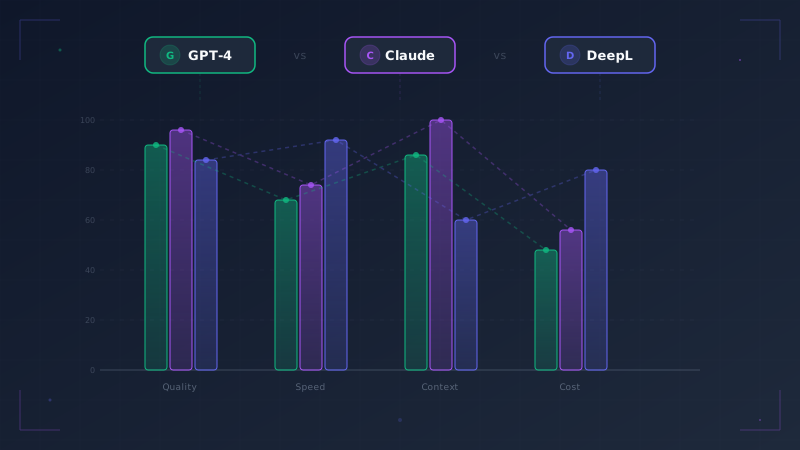
Claude, GPT-6, Gemini and DeepL can all translate your Django .po files well. The differences that matter in September 2026 are price, which model tier you pick, and whether you can pass project context along. This comparison covers the current models from each provider, what the WMT translation benchmarks actually found, and what a typical Django project costs to translate with each.
Every model here works with TranslateBot, either through LiteLLM or through the built-in DeepL provider. If you're setting up Django translations for the first time, the complete Django localization guide covers the setup before you pick a provider.
A note on sources: we haven't run our own benchmark on these model versions. Quality claims below come from the WMT shared tasks and one large industry dataset, all linked. Prices come from each vendor's pricing page as of September 26, 2026.
Quick answer
| If you want... | Use |
|---|---|
| The cheapest good option | gpt-6-luna |
| Best quality per dollar | claude-sonnet-5 or gpt-6-sol |
| Top quality for a launch or marketing copy | claude-opus-5-5 |
| Zero budget | gemini/gemini-3.5-flash-lite on Gemini's free tier |
| No LLM at all, or you already pay for DeepL | DeepL |
TranslateBot's default is gpt-6-luna, so a project that doesn't set a model already uses the cheapest good option.
What the benchmarks say
The most rigorous machine translation evaluation is the annual WMT shared task. Professional annotators rate the output of every submitted system, and the results come out as quality clusters rather than a single ranking.
WMT24: Claude 3.5 Sonnet won
In the WMT24 General MT task, Claude 3.5 Sonnet was the best system overall and won 9 of the 11 language pairs. That was the first time a general-purpose LLM beat every dedicated translation system in the competition.
WMT25: Gemini 2.5 Pro won
At WMT25, Gemini 2.5 Pro landed in the top cluster for 14 of 16 language pairs. Human reference translations made the top cluster in only 6 of the 15 pairs that had them. The organizers note this could reflect "the stylistic or lexical preferences of the annotators", but the direction is clear: frontier LLMs now match or beat professional human references on these tests.
WMT26: not published yet
WMT26 takes place October 28–29, 2026 in Budapest. The findings paper isn't out yet, and the organizers aren't publishing preliminary rankings. We'll update this article when it is.
What production data says
Alconost published 5,632 quality evaluations from real client projects across 85 language pairs in May 2026. Their quality index put Gemini at 77.7, Claude at 75.6, GPT at 73.1 and DeepL at 70.8. They only report vendors, not model versions, and they call it descriptive of their sample rather than an industry benchmark. Treat the gaps as small.
Where LLMs still fall short
Low-resource languages are the weak spot. In one study, English-to-Khmer translation by an LLM scored 39.10 on XCOMET versus 65.88 for Google Translate. If you're targeting Khmer, Lao or Burmese, test carefully and get a native speaker to review.
Automated scores can also mislead. A segment with a COMET score of 0.86 turned out to contain a critical misunderstanding when professionals reviewed it. Benchmarks are a starting point, not a substitute for a native reader.
The current models
Anthropic Claude
| Model | Input / output per 1M tokens | Notes |
|---|---|---|
claude-haiku-4-5 |
$1 / $5 | Fastest, cheapest Claude |
claude-sonnet-5 |
$2 / $10 | Best balance for translation |
claude-opus-5-5 |
$4 / $20 | Anthropic's recommended default model |
claude-fable-5-1 |
$10 / $50 | Built for long reasoning tasks, overkill for UI strings |
Source: Claude models overview.
Claude's strength has always been translations that read as if they were written in the target language, and it follows the tone and terminology rules in a TRANSLATING.md file closely. Sonnet 5 costs less per token than the Sonnet 4.5 it replaced, which makes it the one to start with.
OpenAI
| Model | Input / output per 1M tokens | Notes |
|---|---|---|
gpt-6-luna |
$0.10 / $0.50 | Cheapest current model |
gpt-6-sol |
$2 / $10 | Mid tier, same price as Sonnet 5 |
gpt-6-astra |
$10 / $50 | Flagship, rarely needed for translation |
gpt-4o-mini |
$0.15 / $0.60 | TranslateBot's previous default, still available |
Source: OpenAI API pricing.
gpt-4o-mini and gpt-4o aren't scheduled for shutdown, but OpenAI is retiring some dated GPT-4o snapshots (gpt-4o-2024-05-13 goes on October 23, 2026, per the deprecations page). If you pinned a dated snapshot, check that list.
Google Gemini
| Model | Input / output per 1M tokens | Notes |
|---|---|---|
gemini/gemini-3.5-flash-lite |
$0.30 / $2.50 | Google lists translation among its intended uses |
gemini/gemini-3.8-flash |
$0.75 / $3.75 | Google's recommended model; price doubles on January 1, 2027 |
gemini/gemini-3.1-pro-preview |
$2 / $12 | Preview only, no stable 3.x Pro yet |
Sources: Gemini models, Gemini pricing.
Gemini won WMT25 and tops the Alconost data, so it deserves a spot on your shortlist. It's also the only provider here with an ongoing free tier: both Flash models above can be used free of charge, with rate limits, and Google may use free-tier data to improve its products. Gemini 2.5 models are now only open to projects that already used them, so new projects should start on 3.5 Flash-Lite or 3.8 Flash.
DeepL
DeepL now runs a next-generation LLM model for all its languages (model_type=quality_optimized in the API), and it supports 100+ languages.
The plans changed in 2026. New sign-ups get the Developer plan: a one-time credit of 1 million characters, not the old 500,000 characters every month. After that, Growth costs €23.80 per month billed annually, includes 12 million characters per year, and charges €22 per extra million characters (EU prices including VAT; see DeepL API plans).
DeepL has also added style rules, custom instructions and up to 5 glossaries per request. These help, but they're still more limited than a TRANSLATING.md file, which can describe your product, your audience and your preferred terminology in plain language.
Head-to-head comparison
| Claude | GPT-6 | Gemini | DeepL | |
|---|---|---|---|---|
| Benchmark record | Won WMT24 | No WMT win | Won WMT25, tops Alconost | Lowest in Alconost data |
| Cheapest current model (input / output per 1M) | $1 / $5 | $0.10 / $0.50 | $0.30 / $2.50 | €22 per 1M chars |
TRANSLATING.md context |
Yes | Yes | Yes | No |
| Glossaries / style rules | Via TRANSLATING.md |
Via TRANSLATING.md |
Via TRANSLATING.md |
Native API features |
| Free usage | None | None | Free tier with rate limits | One-time 1M characters |
| TranslateBot setup | LiteLLM | LiteLLM | LiteLLM | [deepl] extra |
What a Django project costs
Take a medium Django project: 500 strings, roughly 10,000 words, translated into 5 languages. We assume about 15,000 input tokens (strings plus TranslateBot's prompt) and 20,000 output tokens per language, because most languages take more tokens than English.
| Model | Estimated cost |
|---|---|
gpt-6-luna |
~$0.06 |
gpt-4o-mini |
~$0.07 |
gemini/gemini-3.5-flash-lite |
~$0.27 |
gemini/gemini-3.8-flash |
~$0.43 |
claude-haiku-4-5 |
~$0.58 |
claude-sonnet-5 / gpt-6-sol |
~$1.15 |
claude-opus-5-5 |
~$2.30 |
| DeepL (~300,000 characters) | Fits in the one-time credit, or ~€6.60 at Growth's overage rate |
These numbers are estimates. Models that reason before they answer, such as Claude Opus 5.5, bill that reasoning as output tokens, so they can cost more than the table shows. After the first run, TranslateBot only translates new or changed strings, so later runs usually cost a few cents at most.
Which one to pick
Start with claude-sonnet-5 or gpt-6-sol if quality matters and you don't mind paying about a dollar per full project run. Claude has the stronger benchmark record (Claude 3.5 Sonnet won WMT24), although no WMT results exist yet for these exact versions. The two cost the same.
Use gpt-6-luna for side projects, internal tools, or a first pass you'll review anyway. At about six cents for the example project, the cost is effectively zero.
Try Gemini if you translate into many languages or have no budget. It won WMT25, scored best in the Alconost data, and 3.5 Flash-Lite is cheap on the paid tier and free on the free tier.
Use DeepL if your company already has a DeepL contract, or you want dedicated MT with native glossaries. Without the old monthly free tier, it's no longer the automatic choice for zero-budget projects.
Mix providers per language. You can use one model for European languages and another for Japanese or Korean. Run the translate command once per provider, each time for different target languages, and switch TRANSLATEBOT_MODEL and TRANSLATEBOT_API_KEY between runs.
How to switch providers in TranslateBot
Switching providers means changing two settings in your settings.py:
import os

# Claude Sonnet 5
TRANSLATEBOT_MODEL = "claude-sonnet-5"
TRANSLATEBOT_API_KEY = os.getenv("ANTHROPIC_API_KEY")

# GPT-6 Luna
TRANSLATEBOT_MODEL = "gpt-6-luna"
TRANSLATEBOT_API_KEY = os.getenv("OPENAI_API_KEY")

# Gemini 3.5 Flash-Lite
TRANSLATEBOT_MODEL = "gemini/gemini-3.5-flash-lite"
TRANSLATEBOT_API_KEY = os.getenv("GEMINI_API_KEY")

# DeepL
TRANSLATEBOT_PROVIDER = "deepl"
TRANSLATEBOT_API_KEY = os.getenv("DEEPL_API_KEY")
For DeepL, you also need the DeepL extra:
uv add --dev translatebot-django[deepl]
To try another model from the same provider for one run without changing your settings, use --llm-model. TRANSLATEBOT_API_KEY is still used, so the model has to match your key's provider:
python manage.py translate --target-lang ja --llm-model gpt-6-sol
Practical tips
Compare on a branch. --dry-run doesn't call the model, so to compare real output, re-translate on a throwaway branch and read the diff:
git switch -c try-gpt-6-sol
python manage.py translate --target-lang nl --overwrite --llm-model gpt-6-sol
git diff -- '*.po'
Write a TRANSLATING.md before paying for a bigger model. Terminology and tone instructions ("translate 'cart' as 'Warenkorb'", "use informal 'du' in German") often fix what looked like a model quality problem.
Have a native speaker check a sample. Benchmarks measure averages. Your checkout page is one specific set of strings.
Watch the Gemini price change. Gemini 3.8 Flash doubles in price on January 1, 2027. It will still be cheap for translation, but update your estimates.
Conclusion
Claude won WMT24, Gemini won WMT25, and in 2026 the gap between the top providers is small. For most Django projects the practical choice is between claude-sonnet-5 or gpt-6-sol for quality and gpt-6-luna for cost, with Gemini as a strong alternative and the best free option. DeepL is still good, but new accounts no longer get a monthly free tier. TranslateBot makes switching between them a settings change.
Once you've chosen a provider, automate your Django translation workflow so new strings never pile up again.